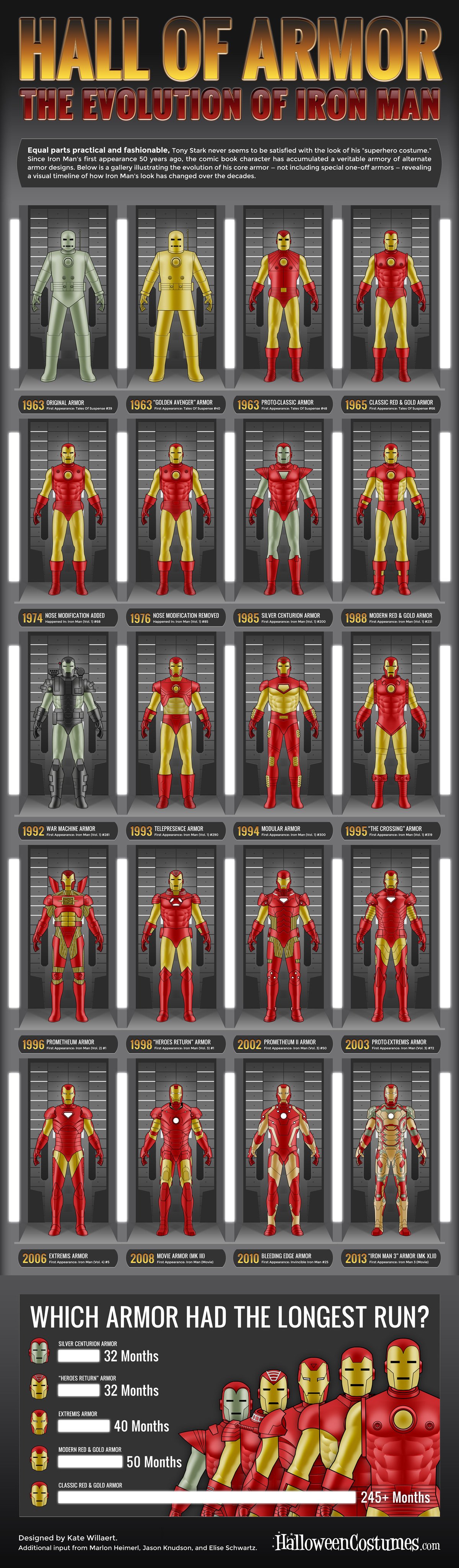
Tony Stark’s first Iron Man suit wasn't a sleek, cutting-edge marvel born in a high-tech lab. It was a desperate, clunky testament to survival, hammered together from missile scraps in an Afghan cave. This raw, improvised beginning set the stage for one of the most remarkable design evolutions in cinematic history: the stunning transformation of Iron Man suits and armor visuals from crude necessity to seamless, nanotech-powered elegance.
The journey of Iron Man's armor isn't just about technological upgrades; it's a visual narrative of Tony Stark himself – a genius evolving from a prisoner of war to a global protector, his suits mirroring every painful lesson and audacious leap of imagination. Understanding this evolution helps us appreciate not just the spectacle, but the deep thought behind every rivet, every repulsor glow, and every iconic splash of red and gold.
At a Glance: The Iron Man Armor Visuals Timeline
- Mark I (2008): Born of survival in a cave; crude, heavy (90 lbs), exposed mechanics, repurposed parts.
- Mark III (2008): First iconic red-and-gold, sleek curves (Adi Granov influence), transition from survival to hero.
- Mark V (2010): The "briefcase" suit, prioritizing portability and rapid deployment.
- Mark XLII (2013): Self-assembling modular plates, AI pattern recognition, remote control capability.
- Mark L (2018): Nanotechnology revolution, materializing from Stark’s chest, self-healing, morphing weapons.
- Mark LXXXV (2019): Pinnacle of nanotech, blending classic aesthetics with bleeding-edge responsiveness.
- Specialized Armors: War Machine (military-grade platform), Hulkbuster (containment focus), Rescue (elegant nanotech for Pepper Potts).
- Visual Language: The enduring red-and-gold, "silhouette" design principle, evolution of repulsor and helmet visuals.
- Real-World Impact: Influencing military exoskeletons and engineering innovation.
The Genesis of Genius: From Cave Scraps to Cinematic Legend
Imagine the scene: Tony Stark, captured and injured, staring at a pile of discarded weapons. His first Iron Man armor, the Mark I, wasn't about heroics; it was a defiant roar for survival. This visual isn't polished, and that's precisely its power.
The Mark I, as seen in Iron Man (2008), was a behemoth of repurposed steel, weighing in at a staggering 90 pounds. Its visual language screamed "desperate engineering." You could see the rough welds, the exposed hydraulic lines jerry-rigged for movement, and the smoke-belching thrusters cobbled together for escape. The backplate of the suit, where the original arc reactor was placed, was exposed, a glaring vulnerability. Joints were clunky, movement was stiff, and its raw, brushed-metal look wasn't an aesthetic choice – it was the unavoidable outcome of limited resources. It looked like a walking tank, not a flying superhero.
These early flaws weren't just plot points; they were foundational design lessons. That exposed reactor? Gone in future iterations. Those clunky joints? Replaced by streamlined servos. The single-use thrusters? Evolved into sophisticated flight systems. The Mark I showed us that even a genius starts with imperfect tools, and that the greatest designs often learn from their initial, often spectacular, failures. The visual of this suit is crucial because it roots Stark's journey in a tangible, almost brutal reality, making his subsequent advancements all the more incredible.
Following the Mark I’s escape, the Mark II emerged as a crucial stepping stone. This gleaming silver prototype, while still lacking the iconic color scheme, represented Stark's first true "clean slate" design in his workshop. Its brushed metal finish showcased refined engineering and improved aerodynamics, setting the stage for the dramatic aesthetic leap that was about to define the Iron Man legacy.
Forging an Icon: The Birth of Red-and-Gold
The Mark III, introduced later in Iron Man (2008), was where the Iron Man we instantly recognize truly came to life. This suit was more than an upgrade; it was a complete visual rebranding. Gone were the crude angles and exposed mechanisms. In their place, we saw the sleek, almost automotive curves heavily influenced by comic artist Adi Granov's designs. The weight dropped significantly, making the suit look and feel far more agile.
Most importantly, the Mark III unveiled the iconic red-and-gold color scheme. This wasn't arbitrary. As artist Ryan Meinerding noted, the palette echoed both the elegance of racing cars and the urgent warning of military vehicles, perfectly encapsulating Stark's persona. It became the visual language of Iron Man – a symbol of power, heroism, and Stark's distinctive flair. This color scheme, first established in the comics in 1963 by Steve Ditko (Tales of Suspense #39), cemented Iron Man's place as a visual icon. The arc reactor, once a desperate power source, now became a subtly glowing chest piece, its intensity dimming or brightening with the suit's energy use, a smart visual cue for efficiency.
Helmet designs, too, began their own significant evolution. Early versions had a more 'bank-vault' faceplate, emphasizing protection. But as Stark's tech advanced, these began to transform. The Mark V, famously featured in Iron Man 2, pushed the boundaries of portability and rapid deployment. Visually, it was a marvel of engineering, folding out of a briefcase into a fully functional suit. Its brushed metal finish, much like the Mark II, was designed to cleverly hide any weld marks, maintaining a seamless, high-tech aesthetic even in its quick-assembly form. This suit's visual impact was its sheer speed of deployment, making it a crowd favorite and a testament to Stark's ingenuity.
The Dawn of Seamless Tech: Nanobots and Adaptive Armor
As Tony Stark's genius continued to accelerate, his suits transformed from complex mechanical exoskeletons into something truly revolutionary. The Mark XLII from Iron Man 3 offered a glimpse into this future, visually distinguishing itself with its modular, self-assembling plates. Watching individual components fly to Stark and click into place, guided by AI pattern recognition, was a dazzling display of next-level engineering. This wasn’t just a suit; it was an extension of Stark's will, anticipating threats and responding almost telepathically.
But the true game-changer arrived with the Mark L in Infinity War. Here, nanotechnology took center stage, fundamentally altering the visual and functional paradigm of the armor. No longer did plates fly or fold. Instead, the Mark L materialized directly from Stark’s chest, spreading across his body in a liquid-smooth, seamless flow. This represented the pinnacle of his design philosophy: immediate, adaptive, and utterly integrated.
This nanotech allowed for incredible visual transformations:
- Self-healing: Damage to the armor would visibly mend itself in real-time, flowing back into place.
- Morphing: The suit could instantly reconfigure into shields, bladed weapons, or even specialized tools, emerging fluidly from its surface.
- Optimized Energy: Power was drawn directly from the arc reactor for peak efficiency, visually evident in its responsive repulsors and weapon systems.
Speaking of repulsors, their evolution was equally dramatic. From the basic concussive blasts of the early suits, they advanced to absorb kinetic energy for supercharged attacks, as seen in Endgame. The visual effect of these enhanced repulsors became more vibrant, more concentrated, reflecting their increased power.
The Mark LXXXV, Stark's final armor in Avengers: Endgame, represented the culmination of this nanotech journey. It was a beautiful fusion of classic Iron Man aesthetics – the familiar red-and-gold, the strong silhouette – with the bleeding-edge responsiveness of nanotechnology. Its helmet, a seamless formation of nanobots, symbolized the ultimate integration of man and machine. This suit wasn't just a protective shell; it was a second skin, a fluid extension of Stark himself. To see the full scope of these design marvels, you can always View Iron Man Pictures.
Beyond Stark: Specialized Suits and Their Visual Language
Tony Stark's brilliance wasn't confined to his own wardrobe. He extended his technological prowess to allies, creating specialized armors that boasted their own distinct visual identities and functional purposes. Each of these suits told a story about its wearer and its intended mission.
War Machine: The Military-Grade Enforcer
Rhodey's War Machine armor started life as a silver prototype, essentially a militarized Mark II. But its visual evolution quickly veered into a far more rugged, imposing territory. Layers of heavy plating, a bulkier physique, and a distinct array of visible weaponry transformed it into a walking arsenal. Over the years, its weaponry shifted from conventional missiles to more advanced sonic disruptors by 2016, a change reflected in its more integrated weapon mounts. The visual cue of War Machine is always about raw firepower and unyielding defense, a stark (pun intended) contrast to Stark's often sleeker designs. Its darker, metallic hues reinforce its no-nonsense, military-grade aesthetic.
Hulkbuster: The Colossus of Containment
Co-designed with Bruce Banner, the Hulkbuster armor is a visual testament to sheer, overwhelming power. Its massive scale and immense bulk immediately convey its purpose: restraining a rampaging Hulk. This suit visually prioritizes stability and strength over agility or flight, though it could manage limited air travel. The hydraulic clamps, visible joints, and modular limbs (famously deployed in the Wakanda battle) all contribute to its image as a heavy-duty containment unit. Every element of the Hulkbuster’s visual design screams "unmovable object," built to absorb and neutralize gamma-powered threats.
Rescue Armor (Pepper Potts): Elegant Protection
Pepper Potts' Rescue armor is a beautiful example of how Stark’s design philosophy adapted to a new user. While mirroring Stark’s helmet design, the Rescue armor featured smoother, more elegant edges, reflecting Pepper’s less aggressive fighting style. Crucially, it retained the iconic red-and-gold scheme, signifying its lineage and heroic purpose. In Endgame, it too benefited from nanotechnology, materializing around Pepper in a seamless flow. Its visuals project controlled power and sophisticated protection, rather than brute force.
Stark's influence even extended to iconic items like Captain America's shield, which he upgraded with advanced sensors to map Steve's movements, making a classic piece of equipment even more dynamic. These diverse armors showcase Stark's versatility, proving his visual design principles could adapt to any challenge or ally.
Bringing the Steel to Screen: Art, Craft, and Digital Magic
The journey of Iron Man's armor from concept art to cinematic reality is a fascinating blend of traditional craftsmanship and bleeding-edge digital wizardry. Early on, the creators understood the importance of grounding the fantastical in the tangible.
For the original Mark I, Stan Winston’s team built a physical helmet from actual metal. This wasn't just a prop; at 90 pounds, it gave actors a genuine sense of the armor's immense weight and physical presence. This practical approach brought a raw authenticity to Stark's initial struggles.
However, as the suits evolved, so did the techniques. Industrial Light & Magic (ILM) became instrumental in realizing the increasingly complex designs. Nanotechnology, in particular, presented a significant visual challenge: how do you make liquid metal look convincing and not just like a blob? ILM’s artists meticulously scanned real Ferrari paint to capture the subtle metallic shifts and reflections, ensuring that the nanotech armor felt grounded and substantial, despite its fluid nature.
The iconic repulsor glows, a hallmark of Iron Man’s attacks, also required creative solutions. Early CGI limitations meant that a simple digital glow often looked fake. To overcome this, ILM used long-exposure photographs of actual light sources, then digitally integrated them into the suit, creating that signature, slightly hazy, yet powerful energy effect.
The blend of practical and digital effects was paramount. Scenes like the removal of the Mark III armor in Iron Man effectively combined partial physical suits with seamless digital extensions. VFX supervisor Ben Snow and ILM’s Jeff White consistently emphasized the importance of "grounded reflections" and "real light references." This meticulous attention to how light interacts with the armor – whether it was real metal or digital nanobots – was crucial for making the suits feel authentic, heavy, and truly part of the cinematic world.
Furthermore, the design philosophy extended to how the suits were perceived. Artist Ryan Meinerding's observation that "great superhero design works in silhouette" became a guiding principle. This meant that even without intricate details, the basic outline and glowing elements (like the arc reactor and repulsors) instantly communicated "Iron Man," ensuring the visual legibility of the armor across all its complex iterations.
The Iron Man Legacy: From Fiction to Future Reality
The evolution of Iron Man's suits and armor visuals has transcended the silver screen, achieving cinematic legend status and leaving an indelible mark on culture and even inspiring real-world technological advancements. Tony Stark isn't just a character; he's become a symbol of innovation, and his armor a benchmark for what's possible.
Engineers in various fields now openly cite Tony Stark in patent filings, acknowledging his influence on their own creative problem-solving. Military programs, most notably the U.S. TALOS (Tactical Assault Light Operator Suit) program, actively develop powered exoskeletons directly inspired by Iron Man's suit. This isn't just a whimsical nod; it's a testament to Stark’s core ethos of protection and leveraging advanced technology to save lives. The visual progression of his suits, from clunky practicality to seamless protection, provides a tangible vision for what future soldiers and first responders might wear.
Stark’s design philosophy – embracing flaws as learning opportunities and prioritizing modularity – continues to influence modern armor development. The Mark I's initial failures directly informed the Mark III's successes, a cycle of iterative design that is standard in engineering. The ability of later suits to adapt on the fly, transforming for specific combat scenarios, has real-world echoes in modular military gear and adaptive robotics.
Looking ahead, the concepts inspired by Iron Man's ultimate armors continue to fuel imagination. We can envision future real-world armor concepts featuring:
- Adaptive Nanobots: Materials that can literally rewrite their code mid-battle, instantly adapting to ballistic impacts, extreme temperatures, or chemical threats.
- Environmental Versatility: Suits designed for deep-sea exploration, extreme atmospheric conditions, or even vacuum, morphing their structure and internal systems to suit the environment.
- Cognitive Integration: Armor systems that anticipate threats and react faster than the wearer's conscious thought, perhaps even projecting holographic battle plans or providing real-time data overlays directly onto the wearer's visual field.
- Beyond Earthly Boundaries: Concepts like cryo-sleep pods integrated into personal flight systems or even rudimentary time-jumping capabilities – the realm of sci-fi, but perpetually pushed by Stark’s legacy.
Even with such futuristic possibilities, one aspect of Iron Man's visual identity remains constant: the iconic red-and-gold color scheme. It's a visual anchor that grounds the ever-evolving technology, ensuring that no matter how advanced or abstract the armor becomes, it always remains unmistakably Tony Stark's Iron Man. The journey from crude cave scrap to a nanotech masterpiece is a powerful narrative, proving that true genius lies not just in the invention, but in the relentless pursuit of perfection, one incredible suit at a time.